
Official San Bernardino County Arrest News
Start with official channels. The San Bernardino County Sheriff's Department posts selected incident releases and social updates, but no complete new-bookings feed. Its public inmate locator covers current custody plus about a month of prior release dates. Booking photos never appear there. The Department says booking photographs are generally not released, and Public Affairs controls any limited official release tied to a public-safety need. One Sheriff post can document an operation without showing everyone booked that day.
City police departments fill part of the gap. The San Bernardino Police adult arrest-log archive is built from adult booking applications and sorted by arrest date and time. The Fontana Police Arrest Media Log is a rolling report with business-day updates. The Ontario Police crime resources pair selected releases with a daily incident map. None of these is a county jail roster. None stands in for a court record either.
San Bernardino County News Outlets
No single paper or station captures each San Bernardino County arrest. Traditional newsrooms lean toward major incidents, prosecutions, public-safety policy, and court results. Community outlets may track just one city. Broadcast stations show up when a story carries broad regional interest. Photo practice varies too. Staff scenes, surveillance stills, court material, and agency-supplied images all beat the routine jail mugshot in frequency.
| Outlet | Coverage and pace | Images and best use |
|---|---|---|
| San Bernardino Sun | Daily and breaking county crime, police, and court news | Staff, scene, surveillance, and occasional agency images; strong county starting point |
| Inland Valley Daily Bulletin | Daily southwest-county crime and public-safety reporting | Similar regional newsroom sourcing; strong for Ontario and Fontana |
| Fontana Herald News | Several local items most weeks | Often follows Fontana Police or CHP releases with staff or supplied images |
| Inland Empire Community News | Episodic San Bernardino, Colton, and Rialto coverage | Community context based on named police and official releases |
| Victor Valley News Group | Frequent High Desert breaking news and some countywide operations | Often credits Sheriff statements and courtesy images |
| San Bernardino County Sentinel | Weekly or episodic long-form reporting | County context, not a recent-arrest feed or mugshot page |
| ABC7, NBC LA, KTLA, FOX11 | Episodic regional breaking coverage | Broadcast stills, video, interviews, agency material, and court documents |
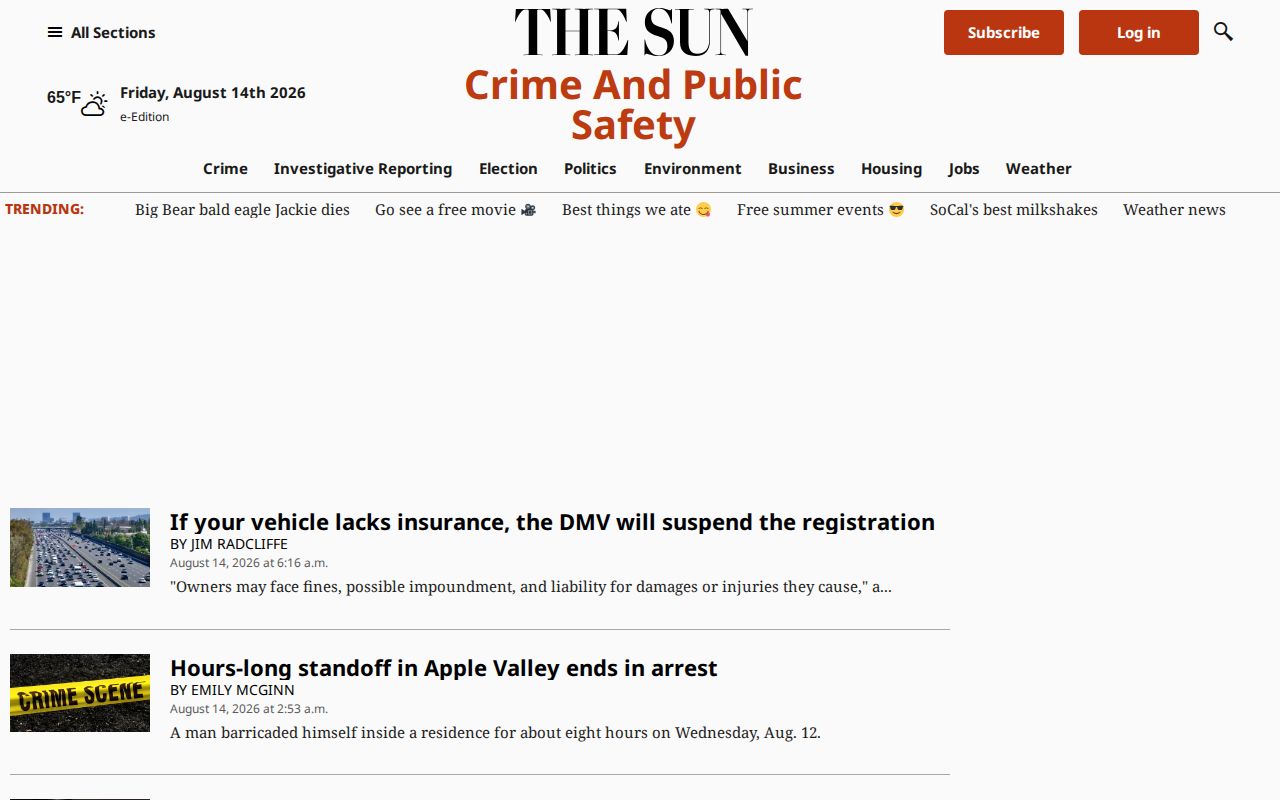
Among traditional channels, the San Bernardino Sun Crime and Public Safety section stands out as the strongest ongoing county news source.
That distinction matters. A newsroom picks events for public interest. A roster answers whether a known person sits in county custody. Silence from one outlet never proves that no arrest took place.
Which San Bernardino County Arrest Logs Update?
The county's three largest cities use three very different publication models. San Bernardino keeps adult logs in an archive. Fontana offers the clearest time-bounded source: a rolling thirty-day spreadsheet updated during normal Monday through Thursday business hours. Ontario has no comprehensive arrest log at all. Its substitutes are selected incident releases and a map that refreshes daily. Each model shapes how you should search.
For a San Bernardino city arrest, check the adult log for the event itself. Then use the county locator for current jail status. In Fontana, allow for a business-day lag and treat the media log as something other than a live custody result. In Ontario, start with the incident map, or a named release if the event drew public notice. A custodial arrest from any of the three cities may enter the Sheriff's four-facility system, and the locator identifies the actual jail.
No official county view exists for everyone booked today. There is no verified twenty-four, forty-eight, seventy-two-hour, or weekly booking feed either. The out-of-custody list is a release view, not an arrest log. For the full county lookup and release-window explanation, see the San Bernardino County busted mugshots search.
Note: A city log describes the arrest event; the county locator and court record answer different questions after booking.
California Law on News Mugshots
News images reach a publisher in several ways. An agency release. A reporter's public-record request. A court exhibit, surveillance footage, or reporting straight from the scene. California's public-records law makes specified arrest facts available within stated safety and investigation limits, though it never expressly requires every booking photograph to be furnished. San Bernardino County's local policy generally declines to release booking photos. So a missing photo is often a policy result, not a broken page.
California Penal Code section 13665 also shapes agency social posts. Subject to listed exceptions, it limits police publication of booking photos for suspected nonviolent crimes and generally calls for removal of posted images within fourteen days unless an exception continues. An agency-run website or jail database sits outside the statute's social-media definition. The rule does not force a newspaper to pull its own reporting. It will not turn the Sheriff's photo-free locator into a mugshot source either.
Note: Identify whether an image came from police, a newsroom, surveillance, or an unofficial index before judging its meaning or age.
San Bernardino County Secondary Crime Reports
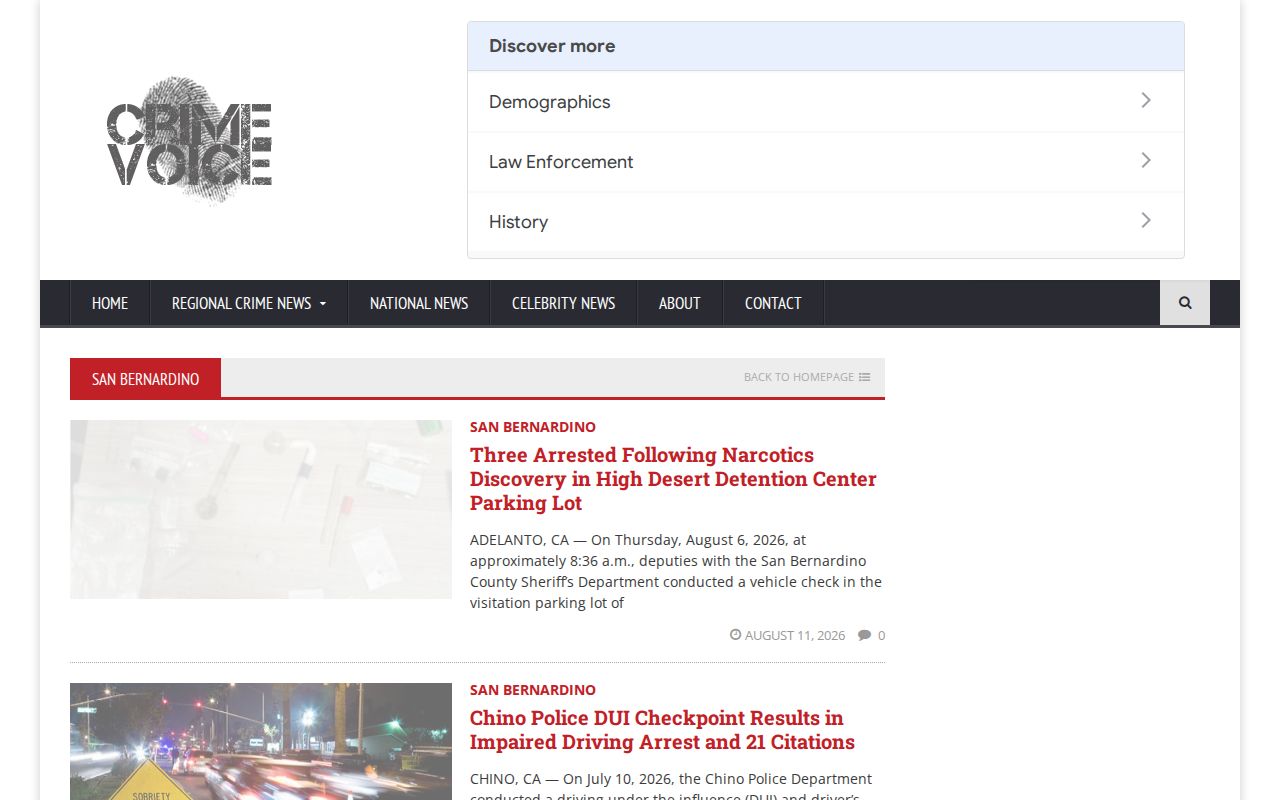
Secondary crime outlets can help locate a name or an older story, but they follow official sources. Crime Voice posts county-filtered reports several times in many weeks, sometimes daily, and usually names the police or sheriff source behind an item. Its pages may carry agency arrest or scene images. Victor Valley News Group republishes some Sheriff operations too, especially recurring enforcement releases. When both versions exist, read the agency release first.
One current secondary view worth checking is the Crime Voice San Bernardino County channel.
For city-level arrest coverage, start with the Fontana Herald News, which leans hard into Fontana stories. The Inland Empire Community News adds selected San Bernardino-area reporting. The San Bernardino County Sentinel brings longer county context, though it moves slower than a booking feed. Daily Bulletin coverage pays off around Ontario and Fontana in particular. Remember how newsrooms work. Editors pick which events earn a story, so no single paper can replace city logs, jail custody data, or the court docket. Treat each outlet as one window on the county, not the whole view.
San Bernardino County Mugshot Indexes
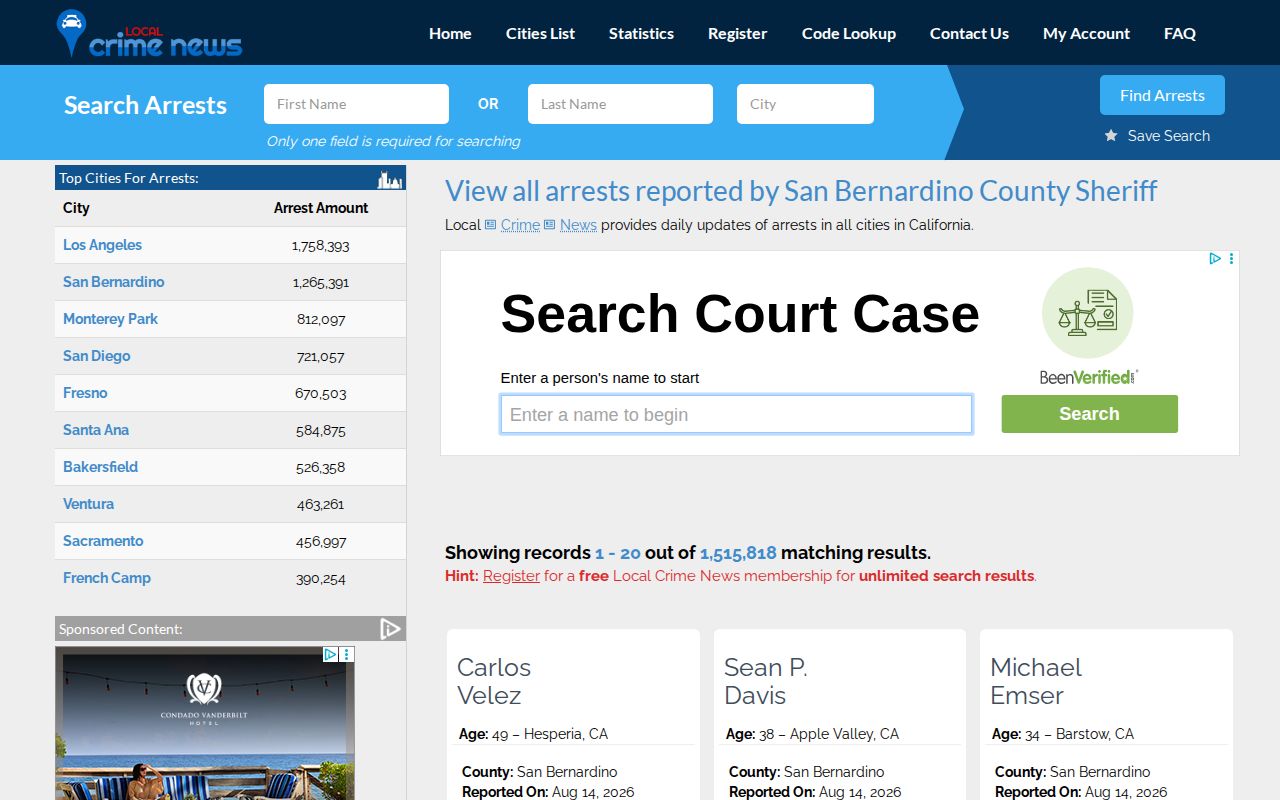
Unofficial arrest indexes deserve more skepticism than a newsroom story. Local Crime News claims daily California updates. Its listings include names, ages, reported dates, alleged statutes, and links to detail pages. City pages exist for San Bernardino, Fontana, and Ontario too. Those pages can blur agencies and counties together, and wider access may sit behind a membership wall. No verified correction policy surfaced there either. The Local Crime News Sheriff-agency view shows the typical format. Rows of San Bernardino County arrest entries come from an unofficial feed, not an agency source.
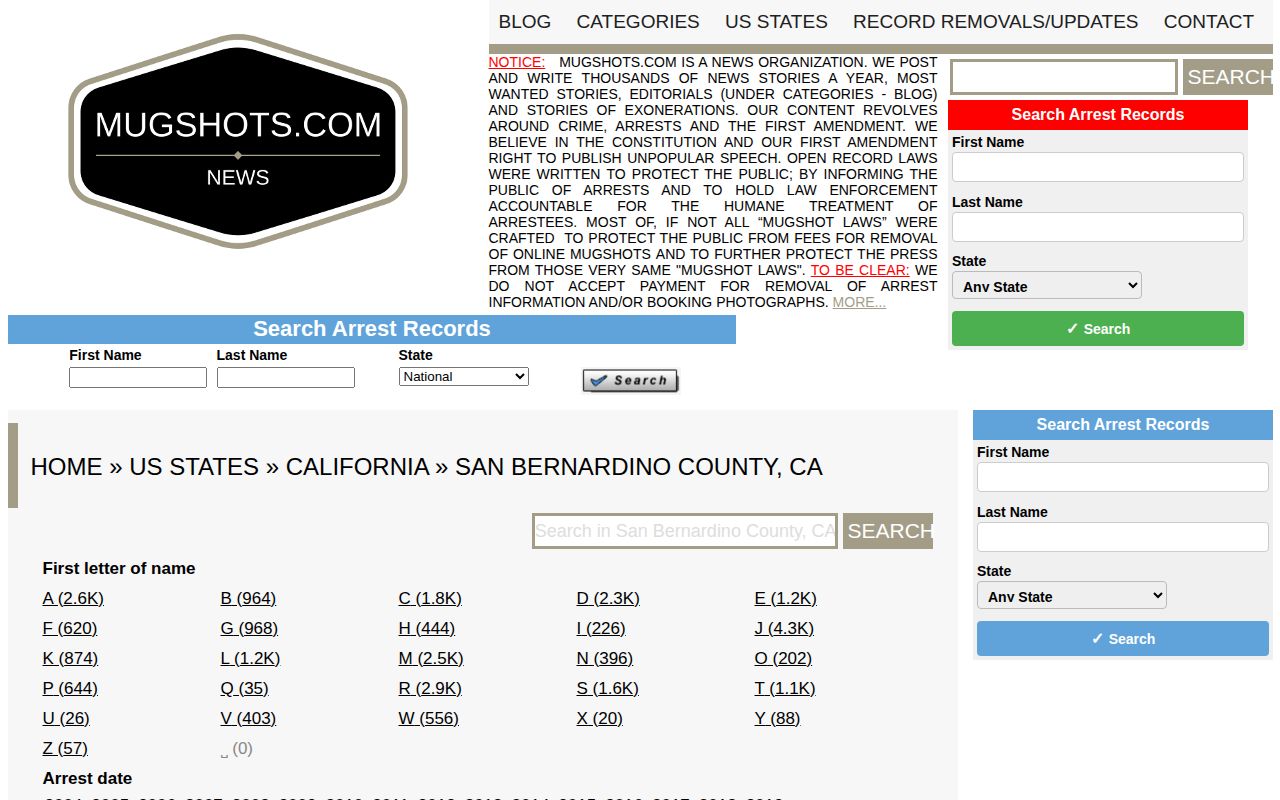
CrimeLocal runs geographic pages for San Bernardino, Fontana, and Ontario. It blends calls and incidents, and its imagery labels can be vague. Treat it as a rough index. It is not a booking-photo authority. Several big aggregators come up empty here. No San Bernardino County section exists on Busted Newspaper or Recently Booked. County landing pages for Arrests.org or Mugshots.zone could not be confirmed. Absent sources should not be dressed up as local coverage. Among the major mugshot aggregators, only one local page checks out: Mugshots.com's San Bernardino County archive. Even that visible archive appears to stop in 2016.
Old captions linger. An aggregator entry can outlast a release or a changed case by years. Match the person with more than a name. Then leave the aggregator behind and verify with official sources, because no third-party image or caption has any pull over a court outcome.
Track San Bernardino County Arrest Cases
A crime story reports an event. It is not a case file. The trustworthy path starts with the agency named in the story and runs to the court disposition, which is simply the result a court records, whether a dismissal, plea, acquittal, or judgment. One wrinkle trips people up. Someone released from custody can vanish from current lists while the arrest record and the news story both stay online, easy to find.
- Read the source line. Note the full name, arresting agency, event date, location, and any case or booking number. Distinguish an arrest photo from a suspect image or scene still.
- Check county custody. Search the Sheriff locator by booking number or identity. A current result shows jail status; the release-date view covers only a limited recent window and displays no mugshot.
- Compare the city record. Use the relevant police log or incident resource. Its initial alleged charges may differ from what a prosecutor later files.
- Find the court case. Search the Superior Court Access Portal by party or case information. Review public hearings, filed charges, pleas, and dispositions.
- Verify the outcome. CAP calls its data real-time but not the official court record. Confirm important details with the docket, a minute order, or a clerk copy.
A matching name proves nothing on its own. Check age or date of birth, arrest date, agency, and location wherever those fields are public. When the locator returns nothing, the explanations multiply. The person may have been released, booked under a different name format, withheld under an exemption, or never transferred into county custody at all. A news image cannot settle any of those questions.
When San Bernardino County Court Records Begin
Why does the first news report so often disagree with the later court record? Timing explains most of it. California Penal Code section 825 generally requires a person held in custody to be presented to a magistrate without needless delay. That clock runs within forty-eight hours of arrest, though Sundays, holidays, and statutory exceptions can shift it. At arraignment, filed charges are read, a plea is entered, and bail gets addressed. A jail's booking snapshot can therefore sit well before the prosecutor decides what to file.
The San Bernardino Superior Court Access Portal offers public case information under state court rules. Expect hearings, charges actually filed, pleas, and dispositions. Take its limits seriously. CAP itself warns that online data may contain errors or omissions and is not the official court record. Older case data run thin there. For an answer that holds up, request the docket, minute order, or clerk copy from the district where the case was filed or heard.
San Bernardino County Custody Boundaries
County, state, and federal custody systems answer different questions. The Sheriff's locator covers people in San Bernardino County detention plus a short recent-release window. Four facilities make up the county system. They are West Valley Detention Center, Central Detention Center, Glen Helen Rehabilitation Center, and High Desert Detention Center. West Valley handles most bookings at the system level. Still, a news report should never assume every arrestee lands there.
A state prison sentence moves a person into the California Department of Corrections and Rehabilitation system. That system is searchable through the state CIRIS tool. Federal custody belongs to federal resources, not the county roster. A city arrest log, meanwhile, records a local arrest event rather than the current place of detention. Keep those stages straight. It is the best guard against mistaking a stale news page for live custody proof.