
Ontario Arrest Booking Records
Ontario Police Department, known locally as OPD, makes the city's arrests. The 2020 Census counted 175,265 residents. That just edges out Rancho Cucamonga among county cities. OPD stands apart from San Bernardino and Fontana police in one key way. No comprehensive arrest log or blotter exists on its verified channels. Instead, the public gets selected incident releases plus a crime map. The city says the map refreshes daily. Neither lists everyone taken into custody.
Most custodial arrests feed into the county jail system. Recent OPD releases often name West Valley Detention Center as the destination. That pattern holds no guarantee for every person. The Sheriff's locator shows the true housing facility. Its fields cover booking, custody status, holds, bail and release. The Superior Court record later shows the filed charges and the outcome.
No Ontario Busted Arrest Log
With no citywide log, the search order changes. OPD's crime resources offer selected releases and a daily incident map. A marker marks a reported event, nothing more. It is not a named arrest, a completed booking, a jail stay, or a court result. Press releases stay selective too. Silence from them proves nothing about whether an arrest happened.
A chosen OPD release may carry a narrative, a public-information contact, a tip line, and a stated booking destination. A few include a suspect photo when police want more victims or tips. That picture serves a case-driven public-safety purpose, not a steady Ontario mugshot stream. It may also differ from the image made at county jail intake. The official OPD crime resources page gathers these incident-oriented city tools in one spot.
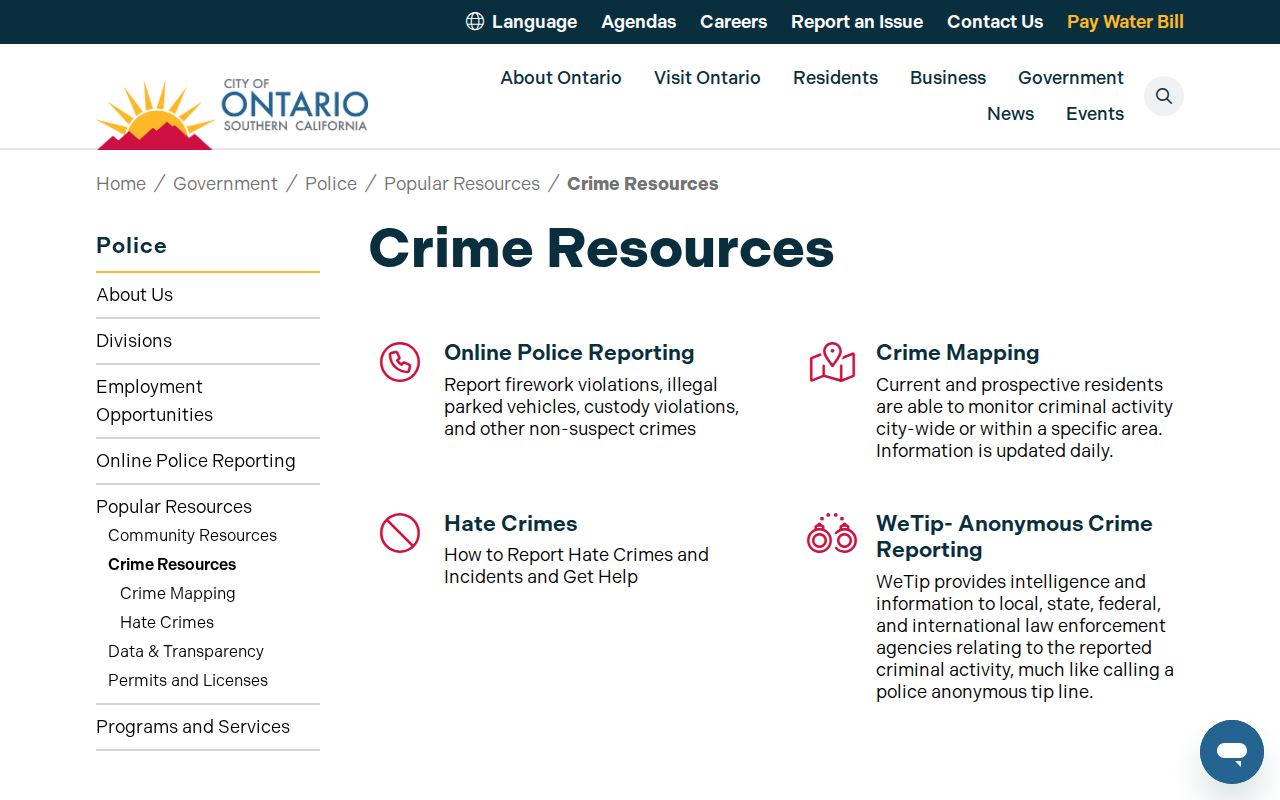
That page helps you find selected police information, but treat it as neither an inmate roster nor a full arrest feed.
Where Ontario Busted Mugshots Appear
Ontario's official path starts with county custody search, not a city blotter. The SBCSD locator shows current jail data and roughly a 30-day out-of-custody view. Both come without photos. OPD releases can add context on chosen cases. A narrow records request can seek a report or an image, though the posted reproduction fees grant no right to a booking photo. Turn to local media and commercial feeds only after the official sources come up empty.
| Channel | Official? | Image? | Correct reading |
|---|---|---|---|
| SBCSD locator | Yes | No | Named county custody, housing and recent release |
| OPD incident releases | Yes | Sometimes | Selected case narrative, not a complete log |
| OPD incident map | Yes | No booking face | Incident place and date, not proof of arrest |
| OPD records request | Yes | Possible, not assured | One identified report, CAD record or image |
| News and unofficial feeds | No | Varies | Secondary lead that may be incomplete or stale |
The Sheriff says it generally does not release booking photographs. The public locator has no mugshot field at all. So a missing face reflects policy, not a broken page. A police image can carry a different purpose and a different publication life than the jail intake photo. Confirm identity through dates and identifiers, never by looks alone.
Busted in Ontario Lookup
No OPD arrest list exists. Search a known person in the county locator first. Then check OPD material only if the city picked that incident for publication. The San Bernardino County booking hub lays out the county roster and release views in full.
- Search the Sheriff’s locator with a ten-digit booking number when known. Otherwise enter first and last name, optional middle name, birth date or approximate age, and gender.
- Match the arrest date, agency, descriptors and housing field. Do not assume WVDC solely because other OPD releases mention it.
- Check OPD releases for the specific event. Use the map only to orient an incident by date and place, not to identify a booked person.
- Request the defined OPD report, CAD incident record or investigation image when public material is incomplete.
- Search the Superior Court case and obtain the docket or minute order for filed charges and disposition.
No county match yet? Try middle-name variations. Intake can involve medical screening, photos, fingerprints, an interview, classification, and housing before the public record settles. SBCSD posts no fixed update delay. If a careful search still fails, the Sheriff points people to WVDC public information at 909-350-2476. A result may also be withheld, filed under another spelling, or held by another jurisdiction.
Note: The county out-of-custody menu lists recent releases, not new Ontario arrests, and a projected release date can shift after a hold or court order.
Ontario Police Arrest Requests
Start with the Ontario Police Records Bureau and the Public Records Request entry on the police site. Describe one identifiable event. Give the person's full name and birth date, the incident date and place, the OPD case number, and the exact item you want. Request the police report and any arrest or investigation image as separate records, so the written report can move forward even if the photo gets withheld.
Ontario's current fees run $35 per police report, $10 for a CAD incident record, and $62 per hour for investigation-photo reproduction. The report fees took effect in July 2025. These are reproduction charges only. They promise neither that an intake photo sits in the city file nor that it must be disclosed. OPD keeps most hard-copy reports for five years, some permanently, but that policy says nothing about the Sheriff's booking-photo retention.
Ontario Police Department2500 South Archibald Avenue
Ontario, CA 91761
Front desk: 909-395-2001
Dispatch: 909-986-6711
Records: Monday-Friday, 7:00 a.m.-6:00 p.m.
Vehicle-release service: weekends, 9:00 a.m.-noon
Booking records for the county sit with the Sheriff, not OPD. So an older or missing jail record goes through the County NextRequest portal. List the booking photograph as a separate item. Digital county productions usually cost nothing. Fees can appear, though, if extraction or programming work is needed. The Sheriff publishes no fixed booking-photo fee. The image itself is never guaranteed.
Ontario Busted Release Patterns
Ontario does not publish on a fixed clock. The police department picks and chooses. A bust involving public risk, multiple victims, or extra witnesses may earn a full press release with details and a tip line. Another gets a one-line note that the person was booked at WVDC. Plenty get nothing at all. That uneven coverage reflects the department's communication choices, not proof that one event happened while another stayed quiet.
The county inmate search covers some of that ground. It lists who is in custody now, plus recent release dates. What does not exist is an official county feed of new bookings by day, hour, or week. The Sheriff sets no refresh schedule. If a clear name search comes up empty, call the information line and ask for the record itself. Keep two facts apart in your head: a person can be out of jail while a case is still open in court.
After a release, the locator keeps entries visible for about 30 days. You can search by the release date. The listing may show release details. But the jail stops tracking court events at that point. For whether charges were filed, changed, or resolved, you need the court docket or a minute order.
Ontario Arrest News Coverage
Newspapers pick up where the city's own log stops short. The Inland Valley Daily Bulletin Crime and Public Safety desk is the best Ontario-focused option around. The San Bernardino Sun reports across the county, and Crime Voice tends to republish what agencies send out. TV stations step in only for big stories. One caution applies here. Photos in news stories are often scene shots, video stills, surveillance frames, or images handed over by police, so a true booking photo is not guaranteed.
Aggregator sites deserve extra care. Local Crime News keeps Ontario city and police pages, yet the material is unofficial and jurisdictions sometimes blur together. CrimeLocal mixes incident reports with routine calls, and neither site holds any real authority over booking photos. For anything that matters, verify the date, the person's identity, and the reported charge against OPD, the jail locator, or the court. More detail on these outlets sits on Mugshots in the News.
Breadth is not the same as authority. Since OPD publishes no full log, unofficial feeds can seem more complete than they really are, and an outdated caption may linger long after a release or a dropped charge. Pin every claim to its source date. Then let the court record settle the outcome.
Ontario Busted Record Stages
A busted record is not one document. It moves through stages. An incident gets reported first. Then comes an arrest, a jail booking, and at last a court case. Paper trails pile up at each step. The OPD map shows where a report was taken, and a press release may describe the arrest itself. For custody questions, the Sheriff's locator confirms whether a named person actually entered the county system and where. The Superior Court record picks up once a case is filed. A state prison sentence sends you to CDCR's CIRIS search, which tracks custody status but shows no photograph.
- Incident
- A reported event, which may or may not lead to an arrest.
- Arrest
- A police action based on an charge, not a conviction.
- Booking
- County jail intake that records identity, fingerprints, a photograph and custody data.
- Disposition
- The court’s official recorded outcome after a case is filed.
Skip the image hunt. A smarter approach treats an Ontario busted mugshots search as a chain of official checks. Begin with the person and county custody. Add an OPD source if one exists for that arrest, request the exact record, and close the loop at the courthouse. That sequence works with the gaps in Ontario's public log instead of against them.